Cursive signature ideas
Joined letters look formal and sign fast — as long as you decide in advance which loops you keep.
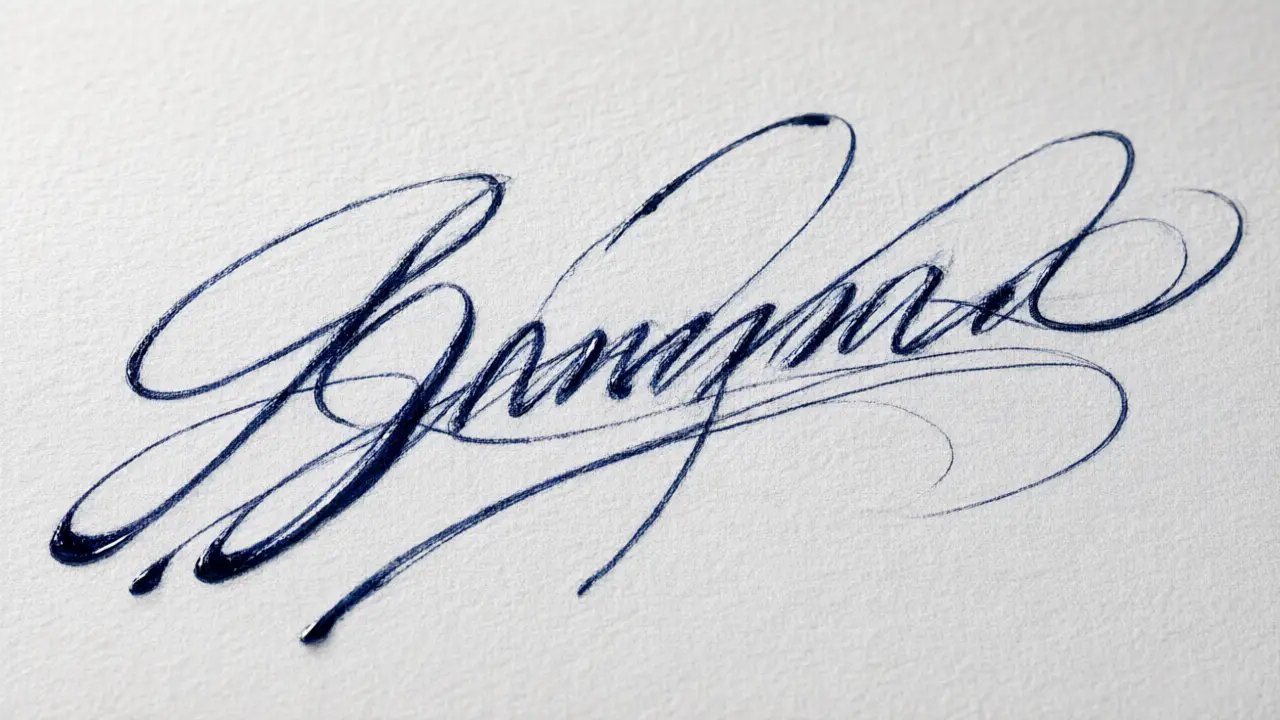
Cursive signs quickly because the pen never leaves the paper: the hand makes one continuous movement instead of six separate ones. That is also why it looks formal — a single stroke reads as practised, not assembled.
Start from what your hand already does
Sign your full name on a blank sheet five times without thinking about it, then mark the letters that came out identical every time. Those letters are the skeleton of Cursive signature ideas; everything else is decoration you are still negotiating with.
The risk is that joined letters blur into a wave. Pick two anchors, usually the capital of the first name and the capital of the surname, and let everything between them simplify into rhythm.
Decide how much of the name survives
A signature is not a spelling test. Most working signatures keep one initial and the shape of the surname, and let the middle collapse into a line — the eye reads the rhythm, not the letters, and the rhythm is what stays the same on a bad day.
Decide the loops before you need them. A signature invented at the counter is different every time, and a signature that is different every time is the one that gets questioned.
Test it where you will actually use it
Try it in a box that is too small, on a phone screen, and on the back of a delivery slip. A signature that only works with a good pen on a flat desk is a drawing; the one that survives all three is the one to keep.
You can build any of these online: open the signature generator, draw or type your name, and place the result straight onto a PDF or Word file. Nothing is uploaded — the document never leaves your device.