Are electronic signatures legal?
In most of the world, yes — with a short list of documents that still want ink, and one habit that decides disputes.
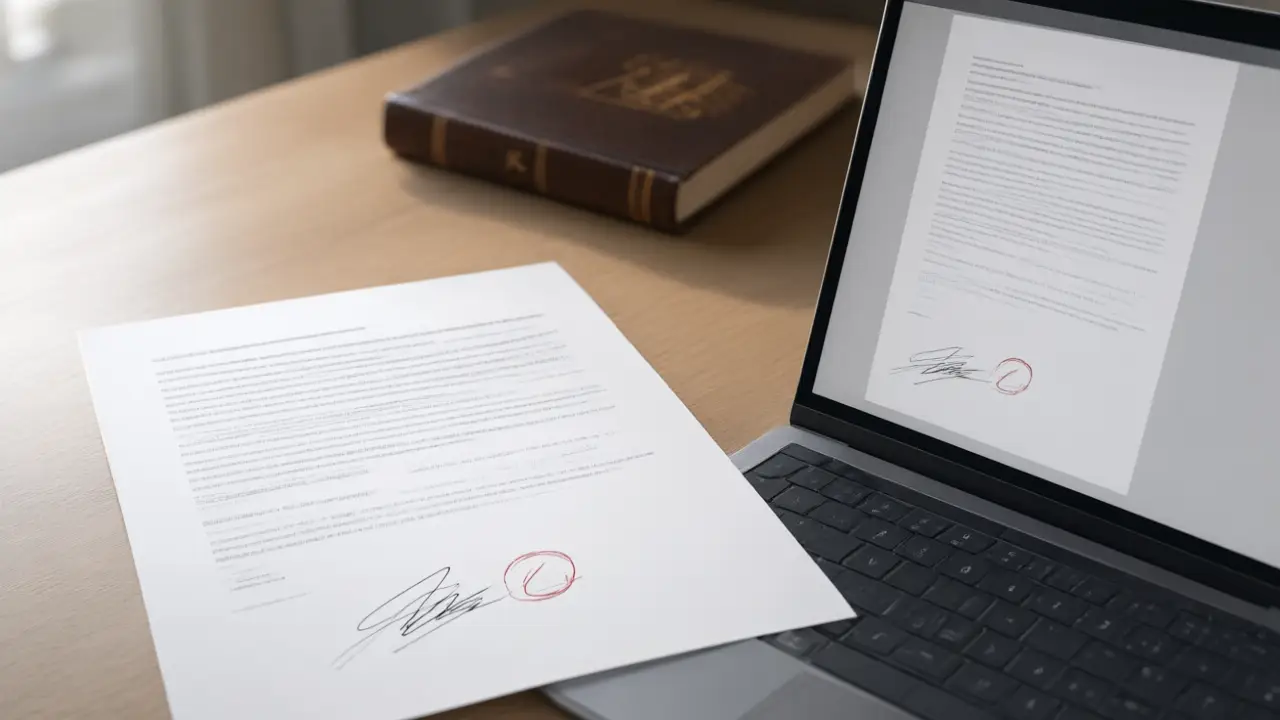
Electronic signatures are recognised across the European Union under eIDAS and in the United States under the ESIGN Act and UETA, with comparable rules in the United Kingdom, Canada, Australia and most other major jurisdictions. The general position is consistent: a contract is not invalid merely because it was signed electronically.
What signing online actually changes
Signing online removes the printer and the scanner, not the commitment: the mark you place still says you read the page and agreed to it. Are electronic signatures legal? starts there, because every technical step below exists only to carry the same intent a pen carried on paper.
The exceptions are narrow but real, and they differ by country. Wills, some property transfers, certain family-law documents and a handful of notarised instruments still expect a wet signature or a specific certified format. When a document or a statute names the required form, that requirement wins over any general rule about electronic signing.
Get the file ready before you sign
Open the final version rather than the draft somebody is still editing, and check that every page and annex is present. Most signing problems are not signature problems at all — they are the wrong file, a missing page, or a scan so dark that nobody can read the clause the signature sits under.
What decides most disputes is not the signature itself but the record around it: who sent the file, to which address, when it came back, and whether the version signed is the version being argued about. A drawn mark with a clear email trail sits in a stronger position than a certified signature nobody can locate two years later.
Put the mark where the document expects it
A signature belongs on the signature line, sized to that line rather than to the page. Too large and the page looks tampered with; pasted as a white rectangle over the text and every reader can see it was dropped in. A close crop with a transparent background is the whole difference between a signed document and an edited one.
So the practical advice is unglamorous. Keep the thread, keep the signed file, and reach for a higher-assurance signature — one with identity verification and an embedded certificate — where the amount at stake or the counterparty makes the extra step worth it. For everyday paperwork, a clear signature and a saved email are what people actually rely on.
Keep the copy that answers questions later
Save the signed file under a name that says what it is and when it was agreed, and keep the message you sent it with. When an agreement is questioned, the argument is almost never about how the signature looked — it is about which version was signed and when, and that is a filing habit rather than a drawing skill.
You can build any of these online: open the signature generator, draw or type your name, and place the result straight onto a PDF or Word file. Nothing is uploaded — the document never leaves your device.